Thursday, March 8, 2012

Born To Make Manifest


 Our deepest fear is not that we are inadequate. Our deepest fear is that we are powerful beyond measure. It is our light, not our darkness, that most frightens us. We ask ourselves, who am I to be brilliant, gorgeous, talented and fabulous? Actually, who are you not to be? You are a child of God. Your playing small doesn’t serve the world. There’s nothing enlightened about shrinking so that other people won’t feel insecure around you. We were born to make manifest the glory of God that is within us. It’s not just in some of us; it’s in everyone. And as we let our own light shine, we unconsciously give other people permission to do the same. As we are liberated from our own fear, our presence automatically liberates others.
--Nelson Mandela  1994 inaugural speech

Enjoy this bright and shining March day, all you brilliant, gorgeous, talented and fabulous children of God! There’s a radiant sky saturated in sun to light your way to your own beauty and, tonight, a full moon to shine light on the path to your own finest dreams. We are born to make manifest a glory that outshines them both. How blessed are we!


Wednesday, March 7, 2012

From Samarkand, With Love


One of my oldest and dearest friends blew into town, yesterday, on the wild and cold March wind. Marcella Baer Sirhandi is one of those people who is literally here today, gone tomorrow, so I dropped everything to spend an entire, glorious day with her. When you’ve known someone for so many decades, there’s much about which to reminisce, plus all the new stuff from the intervening months since our last visit. We sat in our armchairs, tête-à-tête, and talked for hours over tea.

Marcella has led a life of enviable freedom. As a teenager and young woman, she was a horsy gal who barrel raced, as did her sister Barbara, also one of my oldest and dearest friends and a national barrel racing champion. Then, Marcella did an about-face and returned to school, eventually getting her doctorate in southeast Asian art. One story from that period will give you a hint of the flavor of her life.

She was dating a beautiful, tall, artistic black man named Isaiah, who made fascinating sculptures out of bent wire, and who also happened to be a former Golden Gloves boxing champion. One day in 1974, after a long study session, they came out of the university library to find themselves surrounded by the SWAT team! Apparently, someone had reported that the long-sought Donald DeFreeze and kidnapped newspaper heiress Patty Hearst, of the Symbionese Liberation Army, had finally been located.

Around this time, Marcella took off for India, Pakistan and Afghanistan, to see first-hand the art treasures she had studied. She visited Gandara, near Kabul, where Alexander the Great’s culture tinged the Asiatic art with Greek influences, and Marcella somehow managed to wrangle several pieces of this important transitional art for herself. In one of her more hair-raising adventures, she crossed the Kyber Pass over the Spin Ghar Mountains between Afghanistan and Pakistan, and part of the ancient Silk Road, in a bus with no brakes. A young man sat on the hood and threw down a log to stop the wild careen of the bus. She came home from that excursion with her nose pierced, decades before anyone thought that was chic, and she still wears a small gold nose ring.

Marcella became a university professor and has written so many books on her subject that I’ve lost count. Most recently, she wrote one on the royal family of Nepal and I was deeply disappointed not to be able to go to the book launch to which she invited me, as it took place in Nepal and was attended by the royal family. Currently, she’s working on the biography of an important Pakistani artist. She thinks nothing of traveling freely in Pakistan, a place most of us, I’m sure, consider to be a death trap for Western women.

Marcella was briefly married to another professor, a botanist, who discovered a new plant while on a collecting trip in Mexico, and because it has red flowers and Marcella has red hair, he named it after her. “If I’m remembered for nothing else, at least I’ll be in the botany books,” she said, yesterday. Which, I reminded her, is far superior to having a medical condition named after you. For many years now she’s been married to Khalid, a Pakistani, who is a classically trained Indian dancer, a fine cook and an all-around great guy.

Mid-afternoon, we ventured out into the day for a long ramble, with Maclovio, the Chihuahua, in the lead and Sophia, the peripatetic cat, bringing up the rear. It was one of those magnificent March smorgasbord days when a little bit of everything happens: rain, hail, snow, wind, and startlingly blue sky and sunshine. Clouds scudded along, or heaped on the horizon, dark gray and pregnant. We were bundled in berets, scarves over our mouths, dark glasses, jackets and gloves, against the icy wind and the pelting of occasional snow. And still we talked, about what we want to write next, whether we’re really both, once and for all, done with teaching, where we want to travel next. Before we returned to the warmth of the wood stove, we had hatched a plot to go to Nepal together, sometime next year.

As our day wound down, Marcella went to her car and returned with gifts: an embroidered purse from India the color of cinnabar spiced with cinnamon and burgundy; a silk shirt of ravishing peacock blue, with embroidered sleeves that taper to a point in medieval fashion, the tips anointed with hand-wrought brass beads and tassels; and a dress of hand block-printed cotton, in tan, raw Sienna and black, these last purchased in Samarkand.

And where is Samarkand, you may well ask? Well, it’s the second largest city in Uzbekistan, of course! On the ancient Silk Road between China and the West. And where, pray tell, is Uzbekistan? Well, it’s a doubly landlocked country in Central Asia, with Kazakhstan to the west and north, Kyrgyzstan and Tajikistan to the east, and Afghanistan and Turkmenistan to the south. Still confused? Me, too. Next time she blows through, we’ll have to get clarification from Marcella.

Tuesday, March 6, 2012

March Morning


I go out under the cold wind
            looking for the inside of things:

opaline eggs of cumulus
            gray parabolic bellies
                        pregnant with snow;

wildflowers pushing through
            last night's storm crust.

The way sunlight
            lays its fingers
                        along the southward arc

of bare oak branches
            I know
                        it is feeling for a pulse
                        or searching for a hidden latch.

Snow falls in distant columns
            looking more like big,
                        unseasonable smokes
                        rising from river canyon and ridge.

The Sierra crest is curtained
            in mystery
                        like the Tabernacle.

West- and southward
            a jigsaw of cloud-shadowed hills
                        and sun-flooded meadows
                        indigo and emerald.

My pace is slow,
            unmetered
                        I probe everything
                        near and distant:

a horizontal column
            of pineapple smell,  blowing
                        off sun-warmed pine bark;

the tiny chalky cups
            of new moss,  brimming
                        on vermillion clay.

Below, to the west
            the long, undulant torso
                        of ridge

clothed in golden green
            tufts of new oaks leaves
                        annointed in momentary sun

is
            the golden
                        reclining Buddha

his tranquil breath
            whispering the pines
                        a sweet mantrum.

I find
            as with all other Springs
                        that the inside is inviolable

holding
            its sacred fires
                        aloof
                        from mortal probing.

The deep sacraments
            elude me,
                        yet, year after year

I walk            
            this pilgrim's road
                        alert and hopeful.

I know
            there are Sufi saints
                        whirling

in the marrow cells
            of the bones
                        of the world.

I know
            the clouds  give birth
                        to golden sparks,

the air
            is raining
                        white light,

yet bend my knee
            to lesser revelations:
                        lavender quail droppings
                        on white snow;

the song of the rivulet
            in the rut
                        of the road.


Monday, March 5, 2012

The Shoes Off His Feet


One of the things that makes my skin crawl is bigotry. The current political discourse (if one can so dignify the racist, sexist, religionist and elitist babble) is so rife with it that it compromises the dignity of the electoral process. Particularly offensive to me are the attacks on women, the poor, and illegal immigrants, the segments of our society least able to defend themselves and most in need of cultural support and understanding.

I am a woman and I’ve worked side by side with men, doing the same jobs better, and gotten paid half as much. I’ve been poor in my life, and gone without medical and dental care, without educational opportunities, sometimes without hope. And I’ve traveled enough to know how difficult it is to be a stranger in a strange land and to be grateful for the smallest show of kindness from a citizen of another culture.

It’s gotten me thinking about some of those incidents that are what, as they say, makes travel broadening. In particular, I have been recalling the 4000-mile odyssey my friend Javier and I took a few years ago, from one end of Mexico to the other. We were on the road for over three weeks and met many people who welcomed us and helped us in unusual and sometimes extraordinary ways. For example, the cabbie of whom we asked directions, in Mexico City; he was so concerned that we find the right road that he led us for 10 miles through the beastly traffic of that vast city, to our exit. Or the men who poured off the sidewalk in some nameless village, to push our stalled car and then to stand with Javier, with their heads under the hood, until the problem was fixed. Or the old Indian woman who prayed over us in the Colonial period chapel of one of the few haciendas to survive the burnings of the Revolution.

But of all of the experiences of that long and mysterious journey, one incident is outstanding. It began because Javier was in search of a pair of sandals like the ones worn by indigenous people, made from strips of leather and soled in tire tread. As we traveled, we searched every outdoor market, every indoor market, every low-end shoe store. We found huraches by the dozens, but not the particular, very simple sandal that Javier wanted.

Then one day, in a little village on the outskirts of Guanajuato, Javier spotted a pair of the sandals – except that they happened to be on someone’s feet. He hurried up to this person, to ask where he had gotten them. I wish that I could provide a photo of this man for you, but I was too stunned by his appearance to think of my camera.

This man was huge. In his prime he must have stood well over six and a half feet. And he had the massive skeleton of some primeval beast, the kind of thing you see in a museum of paleontology – a sabre toothed tiger or a giant sloth. A kind of Anthony Quinn on steroids.

The only thing was, he was bent almost double at the waist, obviously the victim of some kind of back injury. Javier and I debated it later. I thought he might have worked his entire life in the mines of that area, the same ones that drew the Spaniards there in the 16th century and in which they enslaved the indigenous people. Javier favored the idea that he was a farmer who had spent his years bent over a hoe.

He had hands the size of a catcher’s mitt, gnarled and grimed with use, and he was dressed in the poorest of clothing, the tattered white cotton pants and shirt of the Mexican peasant. And on his massive, calloused feet were the elusive, long-sought sandals. He was, in all, like a massive and ancient oak tree, twisted, rough as bark, broken and healed from winds and weathers and years of patient endurance. He was an icon of the labors that the indigenous peoples of Mexico have endured since the Conquest; a monument to hard work and dignity. I felt a strong desire to fall at his feet and weep.

Meanwhile, Javier was plying him with questions about his sandals and the man was answering in a Spanish so deep, so close to a growl, that I couldn’t understand it. Finally, Javier shook the man’s hand. He held it in two of his own for a long moment, and he bowed slightly over it, in respect. When Javier came from the shade of the arcade out into the street where I stood waiting, he had a strange look in his eyes.

 “What happened?” I asked. “Did he tell you where to find the sandals?”

“He made the sandals, himself,” Javier replied. “I asked him if he had any more like them, at home, but he said no. And then,” Javier’s eyes brimmed with tears, “he offered to give me the sandals. To just take them off his feet and give them to me. Can you imagine?” I looked toward the arcade. There, his massive back laboring under the effort to walk, went the simple man whose heart was a huge as the rest of him.

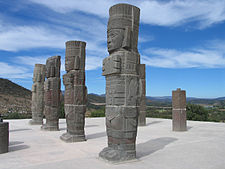
Eventually, we found a pair of sandals in a bin of handmade shoes in an indoor market in Guanajuato. Javier was thrilled. He wore them throughout the remainder of our journey. When we got to the ruins of Tula, the thousand year old Toltec capital, we discovered that the monumental warrior figures were wearing the same sandals. The huge warrior columns reminded us of the great man who had offered us the shoes from off his feet.


That’s the Mexico I know, where the poorest people are the most gracious, the most welcoming and the most generous. When I hear politicians demeaning Mexican immigrants, my blood boils. I wonder, if I were to inquire about their shoes, if any one of them would offer them to me. Somehow, I doubt it.


Sunday, March 4, 2012

Another Billy Whiskers Morning


Yesterday morning, my husband and I went down the mountain to Bill Whiskers, our favorite breakfasting place, which some of you may remember from my blog post of February 5th. If we arrive early enough, we usually have the place and the owners all to ourselves, which means we can all have a really good gab fest before their morning pace picks up. Luck was with us and, as we walked in, only Karen, Rick and Coco, the feral cat, were there.

Coco is a silky charcoal and white striped tabby who is independent and peripatetic. She has the run of Billy Whiskers, plus the Mexican restaurant to the south, the Presbyterian Church of the 49ers, to the north, the Gypsy Field and The Rocks (see posts 11.15.11 & 11.17.11). She sleeps in a ramshackle shed behind the restaurant, or wherever else she pleases, and likes to amaze diners, many of whom are tourists and not accustomed to such rural intimacies, by bringing her latest kill in to show it off. Once, it was a live snake and the woman to whom it was presented screamed, “Snake!” and was extravagantly unhinged.


And once, Karen recounted, Coco was locked in the church by accident. I was just about to say, “Church mice, beware!” when Karen added, “And she caught a HUGE rat!” For Coco, wherever she goes, it’s literally breakfast on the house. So important a fixture is Coco that Karen, who is trying to sell the business so that they can retire, has put her into the contract. Either Coco and her future are assured or no deal.

Of course, eventually we had to discuss the weather. It’s been such a mild winter as to be scarcely a winter, at all. Which brings up the topic of water, since, without a big snow pack in the mountains, there is no water to see us through the summer months. Water is a precious commodity in these hills. Some people are lucky enough to have a good well or even a spring on their property. Some live close enough to the ditch that conveys our water down from high country reservoirs to have cheap, untreated water for their gardens.

But for those of us on the water systems of the local utility district, water comes at a big cost – and it was just announced in the paper that we should already be limiting our usage. It was the unanimous opinion of all present, except for Coco, who abstained, that the utility district would use this crisis to push water prices to astronomical levels, an agenda they have been pursuing relentlessly, anyway.

There was also the issue of Hetch Hetchy for us to consider. It’s the reservoir behind O’Shaughnessy, the dam that was thrown across a high country valley that was said to rival Yosemite Valley in scenic splendor. John Muir, the founder of the Sierra Club and called the Father of the National Parks, fought the dam, which was approved by President Woodrow Wilson in 1913 and was completed in 1923. It is said to have broken John Muir’s heart.

Our local U.S. Representative has just introduced a bill in Congress to have the dam taken down, but as it is the main source of water for San Francisco, it seems unlikely that this will happen. When my father was a Tuolumne Country supervisor, over 50 years ago, he fought long and hard to have San Francisco remunerate Tuolumne County for the water they freely take from us, through the Hetch Hetchy system. He was unsuccessful and, as a result, citizens of San Francisco have cheaper water rates than we do in Tuolumne County, the source of the water. That fact was a dose of bitters to accompany our otherwise excellent breakfasts.

We also spent some time examining the fascinating artifacts that Karen and Rick have collected and arranged artistically on walls and shelves. One item was a rusted spike of metal about 7 inches long, with a loop at one end and a smaller loop, just below that. “What do you suppose that is?” David queried. Karen said she’d found it in the tailings of a mine on their property. The miners stabbed the spike into the walls of the mine. The smaller loop held a candle and the larger loop, into which about 3 fingers could be inserted, or the small end of a pick blade, was for pulling it back out, again.

This same mine, they believe, is now flooded and they are hoping to open it and access the water, for their gardens. They live in one of the original farm houses of Columbia, surrounded by old fruit trees. It’s not uncommon  to have mines on one’s property, in this area that was one of the epicenters of the 1849 Gold Rush. We have 2 mines on our own property. My father used to try to get me to go into them with him, but I was always afraid. I would go about 5 or 6 feet into the entrance, right about where the real gloom started, and go no further. They were neatly dug, squared off, the floor leveled. Pick marks were still visible in the walls. But what really interested me as a child were the heaps of quartz crystals outside, that flashed seductively in the sunshine.

Then, we examined a hand-forged cowbell that had been given to Karen by Marie Rouse, the long-time post mistress of Columbia and that was probably manufactured by Marie’s father. It is a lovely heart shape of rusted metal, with a hand-carved wooden clapper. This led to Rick telling a riotous story about when he was a young cowboy in Indian Valley. Rich people bought the ranch where he worked and conceived the notion that it would be a romantic thing to hear the sound of cowbells, throughout their property. Now, typically, you put a bell on the lead cow, some old, quiet girl that the others like to hang around with. If you can hear her bell, you know where to find the other cattle, too. But these folks had a bell installed on every single cow. In Rick’s laconic words, “after the cattle had stampeded and torn down the corral, they decided this wasn’t such a good idea.”

Just as we were finishing the last morsels of our breakfast, Rick said, “Uh oh! Here comes old Know-It-All.” “Who’s that?” I asked. It was a merchant from Columbia and his wife – his fourth wife, Karen added – and although he was newly arrived in Columbia, having lived here for only 6 years, he considers himself quite a local history buff. In he came, dressed in 1840s fashion, as is required by the State of all concessionaires in the park: a black top coat with a gold watch fob, a vest, shirt and cravat.

David and I excused ourselves and left, shortly after he and his wife were seated. And I knew that the minute the door closed behind us, this fellow would ask “Who was that?” and the gossip would be flying, again. “That’s Suzan Still. She and I grew up together . . . ” Etcetera, etcetera, etcetera: another typical Billy Whiskers morning, in progress.


Friday, March 2, 2012

Fiesta of Smoke: Introducing Hill


Today’s post is an excerpt from my novel in progress, Fiesta of Smoke. This snippet introduces the third of three protagonists, Hill, one of Calypso’s two love interests. The manuscript for Fiesta of Smoke now numbers more than 830 pages and I’m excited by my vision for the closing chapters. So, back to writing. I hope you enjoy today’s excerpt!

For those who might have missed them, a synopsis of Fiesta of Smoke can be found on the January 5, 2012 post, the Prologue, on January 8, an introduction to the protagonists Calypso, on February 3 and Javier, on February 20.

Paris, 1995
Hill

         Culturally, so much depends on the placement of the body in space. For the French, there are three reasons why one might sit alone at a café table: one is waiting for a friend; or is an intellectual, solitary and brooding; or one is a tourist. Of them, the first is most acceptable, the second, merely suspect, and the last, contemptible.
         Perhaps his patina of world-weariness leads the woman who serves Hill his café au lait, carottes raspés and hard, butterless bread to believe he is the suspect of the three. In a neat dark skirt and white apron, she whisks to his table on the basic black pumps that are de rigeur for the Parisian working woman and deposits his food without the familiar buoyancy offered natives but also minus the blank reserve that walls out the taint of the étranger.
         He is a creature apart, her actions tell him. Having been so on every continent for the last twenty-five years, he accepts her appraisal without surprise or resistance. He is, in fact, vaguely pleased to find his grimy psychological camouflage intact.
         This café on the Île Saint-Louis is a favorite of his, although the prices are high and the food poor, fit only for the clientele of footsore tourists who manage to limp over that plainest and most utilitarian of Parisian bridges, Pont Saint-Louis, in search of both a place to sit and of caffeine. The problem lay less in their feet, he always suspected, than in the daunting effect of the first tour of Notre Dame.
         From this vantage point on Quai d’Orleans, the cathedral rises majestically across the intervening channel of the Seine, completely dominating the tail of the Île de la Cité, startling and grand as a newly-erupted volcano. He watches the intermittent stream on the bridge: stolid German matrons in square wool suits and flat, thick-soled walking shoes; scruffy kids of indeterminant nationality in battered tennies and baggy pants, lugging backpacks; a flotilla of Japanese, all grinning, like a cloning experiment rejoicing in its escape from the laboratory.
         At some point, almost all hesitate near mid-bridge, glance tentatively back at the cathedral, perhaps snap a quick picture, and then hurry on, with a shake of the head or a hunching of the shoulders like a repressed shudder. They sit, then, over their coffees with the stunned look of survivors of cataclysm. Perhaps the fifth whirlwind day since Brussels has undone them. More likely, Hill suspects, it’s the ecstasy of the 13th-century conception that has brought their cold chrome-and-glass hearts to bay. Notre Dame smells of mold and smoke, but she steps like a stone foot on contemporary notions of aesthetics.
         Fluctuat nec mergitur is the city’s proud motto: She is tossed but does not sink. The cathedral is the giant poop deck of the boat-shaped Île de la Cité. Other cathedrals rise to greater heights, have vaster expanses of colored glass, better acoustics, embody more purely the Gothic conception. But for Hill, this-- this edifice, this spot of land--not Rome, is the beating heart of the Church. If one could not smell the odor of sanctity here, one would never do so. It saturates the ground so that, even walking in the Bois or shopping on Rue de Rivoli, the cathedral, hidden from sight, still vibrates in the mind.
         Paris always puts Hill in this mood. Bangkok, Tokyo, Montreal, D.C., Santiago, Baghdad--they have their charms, of course, but he can remain detached, do his job free from his own psychological tints. But Paris! He approaches her like a lover. Twenty-five years as a foreign correspondent drop away and he is a besotted adolescent, or a mendicant monk, finally come home to the City of Light.        
         He deliberately does not recall, at this juncture in his musing, the gold watchcase in his inner pocket, although he pats it through the tweed of his suit, as he does habitually several times a day. It contains: a tiny basaltic chip of the Elura Shiva, from Mt. Kailasa; a small gold nugget given to him in Denver when he was ten by his paternal grandfather; and a gelatin capsule which once held crystalline ascorbic acid, but now contains a minute rag of cloth, stained brown. This last, a ripped-out portion of an Egyptian cotton handkerchief, has absorbed into its closely-beaten warp and weft, like a dead bird still kept in a cage, a speck of Sadat’s blood, spattered on Hill’s hand that fateful day in Cairo.
         So Hill, 20th-century man, for a lifetime fingering the fevered pulse of events that anticipate the 21st, is yet susceptible to the old gods and the blood of martyrs. And Paris is the reliquary where he keeps all his atavistic tendencies.
         He orders another café au lait and sinks his upper lip into its bitter foam. Across the river, the cathedral’s bones are picked out florescently in the brilliant November light. The great arching buttresses seem not to pass the immense weight of the walls into the earth, but to exist simply to exhort them upwards. White flecks of pigeons sail through the stone lacework of the arcs and spires like liberated souls or embodied prayer.
         It is this back view, with all her props and braces, that Hill loves in Notre Dame. The facade always seems too austere, too foursquare, with its truncated spires. No, Notre Dame reveales her true grandeur to those who flank her from the Quai aux Fleurs and come with amazement on those arcing arrows of stone.
         He likes to think that these frazzled tourists around him have been struck by those arrows; that, born into a time when art is preciously self-conscious, they still can be smitten by Our Lady’s mathematical formulations expressing profound intuitions about the nature of God. True inspiration not only utilizes but demands precise formulas. Our Lady of Paris, a most voluptuous creation, combines elegance and spiritual grace: the more abstract the truth one wishes to teach, the more it is necessary to beguile the senses with it . . .
         Hill, you old lech. Slobbering into your coffee over the Virgin, again. Time for a good war somewhere, before your brain rots out completely.
           He fishes in his pocket for some 10-franc pieces and begins to push back his chair, when his eye lights again on Pont Saint-Louis. There is a woman there, mid-span, facing the cathedral. She is wearing a full-skirted dress of yellow, and the afternoon sun slanting through it gives hints of a long and lithe body. But more remarkable, she has one leg stretched out on the railing and is rhythmically lowering and raising her torso to her extended knee, in long, balletic stretches.
            Now here is a backside to give the Virgin a run for her money!
         Hill had missed F. Scott and Zelda Fitzgerald zipping around on top of taxis and bathing in public fountains but he’d always been in sympathy with their effervescence, so more than the newsman in him is immediately attracted to this woman on the bridge. Either she is a certifiable loony or an enchantingly free spirit. He leaves a 5-franc tip to propitiate the gods and threads out through the metal chairs.


Thursday, March 1, 2012

Time Out

Good morning, all. I'm under the weather, this morning. There's black ice on the road; my car has a foot of snow frozen all around it; and the front stairs are icy. Altogether, a good day to stay inside by the fire and rest. Also, to continue my research for Fiesta of Smoke. I expect to be back in action tomorrow.

Blessings!  SS