Saturday, April 6, 2013

Contemplating Pancho: More About Fiesta of Smoke


 At the feet of my hero, at his ranch near Parral, Chihuahua

A large black-and-white photo of Pancho Villa sits on my desk. He’s on horseback, riding straight toward the camera, bandana around his neck, hat pushed back so strong light floods his sweaty forehead and big black moustache. His horse is at a gallop, lathered with sweat, and dust rises under its hooves. Behind them, horse-drawn caissons rumble and a crowd of horse cavalry, guns and banners jutting, gathers in the distance.

I am stunned by the drama of this photograph. No matter how often I glance at it, or gaze, as I do many times a day, an urgency and a terror grips me. This is war, the Mexican Revolution of 1910. This man and those who followed him put their lives on the line for an ideal: freedom.

For more than thirty years I’ve traveled in Mexico, into the interior where the anguish of the Mexican people is unvarnished by tourist trappings. It’s become clear to me that the freedoms gained in the Revolution are being lost and that the desperate plight of the poor remains. In many ways, the Conquest of the 1500s is on-going, with the pillaging of land transferred from the Spaniards to multi-national corporations and corrupt politicos.

Fiesta of Smoke was born out of these observations and ponderings. How does social transformation occur? What are its mechanisms, driving forces, psychology? Who are its leaders and what motivates their incredible sacrifice? Does every age produce a Pancho Villa, willing to ride through the night from one battle to the next, to live lean and forego rest for an ideal? These questions began to congeal into images. And thus the insurgent Javier Carteña entered, tracked by international investigative reporter, Hill, who asks the same kinds of questions:

         Staring up from the flap of the book’s dust jacket was Dr. Javier Carteña. Hill bent over the small black and white photo like a virologist discovering a new germ.
         The face that stared back at him was handsome in the way that fighting bulls are--full-boned, brave and powerful. The eyes did, yes they did indeed, smolder. The mouth was full-lipped and slightly drawn down in the corners, as if at any moment he might bark an order that would carry no compassion but strike one senseless like the stooping of a falcon. It was the face of a monastic--solitary, disciplined, tortured down deep. Calypso had called him a "warrior-priest," his wife and children notwithstanding. A head of glossy black hair filled what was left of the photo.
         He buttoned the top button of his overcoat, gathered up the book. The first thing to do, of course, was to call the publisher. He set off down the street quickly, smiling to himself. Now he was in his element! Now, there was a scent to follow.

Caught between the two men is Calypso Searcy, a successful writer, whose adolescent love affair with Javier Carteña has impacted her life for twenty-five years, and whom Hill has just met:

         Hill fished some ten-franc pieces from his pocket and began to push back his chair when his eye lit again on Pont St.-Louis. A woman stood there, mid-span, facing the cathedral. She was wearing a yellow dress and the afternoon sun slanting through it gave hints of a long and lithe body. But more remarkably, she had one leg stretched out on the railing and was rhythmically lowering and raising her torso to her extended knee, in long, balletic stretches. Intrigued, Hill left a five-franc tip to propitiate the gods and threaded out through the metal chairs.
         A red fox coat, heaped on a big oxblood-colored leather bag, glowed like a fire at her feet; and she was humming the strains of Zum reinen Wasser: “Where streams of living water flow, He to green meadows leadeth...”
         Leaning casually against the railing about four feet away, a distance he deemed friendly but not overpowering, Hill ventured: “I love Bach, myself.”
         “Truly,” she said.
         Thirty years of savoir-faire melted and Hill was a fuzz-faced lout from Denver again, all elbows and size-16 shoes. “One of his loveliest . . .” he managed to stammer, “his finest cantatas.”
         Time for pure out-West charm--ingenuous, all-man, no horseshit.
         “Listen,” he said, “I know just from looking that you and I are as different as hog wire and harp string. But if you’re not otherwise engaged, I’d be honored to take you to an early supper.”
        
It quickly becomes apparent to Hill that Calypso is in some kind of trouble, and when she disappears, he sets out, using his investigative skills to track her, first in Paris:

         The room Hill entered was a perfect exemplar of early seventeenth-century architecture, long and narrow, with a high ceiling, windows at the end giving onto the street, and a marble mantle framing a small fireplace. Orderly, it would have been a lovely room. The degree of disruption alarmed him. Rugs were pulled up, sofa cushions slit and books pulled from their shelves into splayed heaps. He bent and picked one up at random. Ombre et Soleil, the poetry of Paul Eluard. It had been so badly manhandled that the center pages fell out with a thunk.
         “Oh non, monsieur!” Madame Pouillon shrieked. “You must touch nothing!”
         “But, what possible difference . . .” he broke off, gesturing at the incalculable mess.
         “Yes . . . but no. You must not touch Mademoiselle’s things. On this I insist!” Hill nodded, trying to keep down his frustration. He had to work fast, before she insisted he leave altogether.

Then to California, New Mexico and Arizona, following Calypso’s swiftly vanishing trail, and finally arriving in southern Mexico. Meanwhile, Javier and Calypso recall their youthful bonding in Berkeley in 1966:

         Javier would never forget the afternoon he brought Calypso home from the hospital, so agonized she could barely breathe. He laid her on the bed and gingerly removed her sweater and jeans. It was his first full view. Her entire body was a patchwork of bruises and lacerations. Only her ankles and feet seemed to have escaped unharmed. "My God, Caleepso! My God!" was all he could mutter. He sat on the end of the bed and massaged her feet, the only part of her he dared touch, until she fell asleep.
         Her general demeanor impressed him. She was calm, serene and patient with herself, and grateful, although not servilely so, in her reliance on him.
         "Caleepso, I am impressed with you. You are very strong."
         She was sitting in her big armchair with a mug of steaming tea. Late afternoon sun streamed obliquely, setting her long dark hair ablaze with red highlights.
         "Something happened to me, in there."
         "Obviously . . ." He waved a hand at her, as if to ask if she thought he was blind.
         "No. I mean something . . . wonderful. Something . . . sublime."
         "Tell me."
         No words for the ineffable, he thought, as he listened to the stammering account of her experience after the rape. Had she been delirious? Dying? Mere language could never convey the wonder he saw sweeping her face. Something profound had happened to her. Who knew better than he what lovers pleasure and pain can be, how intimate their dance and how seductive?
         "I see you, Caleepso," he said when she had lapsed into silence. "I see your soul."
         The room was in cloistered darkness. They sat, with the hiss of the radiator and the background roar of evening traffic, in silence. At that moment, they both knew the truth: there would never be another human being as intimately, inextricably bound to them as they were to one another.

Revolutionary fervor heats up, then boils over:
         She ran. Lights swept across the ground, and in the strobe effect, Calypso saw running figures, then blackness, then again, people running, pulling sleepy children behind them or carrying them in their arms, and then again, blackness. A shot rang out. Then another. In one of the sweeps of the lights she saw someone lying on the ground. Then another.
         Suddenly the selva rose before her and she slammed into a wall of vegetation. A searchlight swept across the foliage to her right, its arc about to encompass her. More shots. Calypso dove to the ground. Pulling herself forward on her arms, she clawed beneath the forest understory like an animal desperate for safety from the madness of humankind. . . .

. . . Sleep evaded Javier. He was cold. He suspected it was not just the wind that was making him that way. A knife of ice had been inserted in his guts, the moment he stood on the empty lakeshore. If anything should happen to Calypso, he would never be warm again. But it was so careless of her to do this! She was causing him trouble when he had enough already. She was risking the safety of the operation. When she finally came wandering back, he’d send her packing. She had no business in this place, where she didn’t have the slightest understanding of the seriousness of things.
         He tried to make his anger heat him. It failed.
         Sometime in the darkest part of the night he finally must have dozed, because when he jerked awake, Pedro was standing by the bed, ghostly through the mosquito netting. “Boss! Wake up! There’s trouble! Get your boots on. We gotta go!”
         Javier threw aside the blanket and netting and was on his feet in an instant, reaching for his shotgun. “What?”
         “It’s the village, Boss.”
         “What village?”
         “The one where Calypso is.”
         “What about it?”
         “Come on, Boss! It’s under attack!”

         I sit gazing at Pancho Villa. His eyes are inscrutable. There is no hint of what drives a man so fiercely to risk his life in a cause that could just as easily fail as succeed. As Fiesta of Smoke gestated and grew, it became clear that love is a motive force the power of which is incendiary and unfathomably profound. Fiesta of Smoke is a study in history and cultural transformation, yes. But even more, it probes those vulnerable, wounded places haunted by Eros: romance, sexuality, friendship, patriotism, and the passion for freedom at all costs.
         In the thirty years it has taken to write this book, the love between Calypso and Javier has demanded to be recorded, and so has their passion for social justice. During those three decades, actual events in Mexico have demonstrated that these two were not misguided: the people are rising up, acting out one of the great dramas of the twentieth and twenty-first centuries,  offering their lives to the dance that is a fiesta of smoke.

Wednesday, April 3, 2013

I'm Back!


I'm back! I thought you'd like to see a photo, to be sure I'm for real after all this time, so I just snapped this one in the bathroom mirror. That's why I look a little fuzzy--although it may also reflect my mental state. Please excuse the 9-month silence. I'll explain later. For now, I have an announcement: my second work of literary fiction, Fiesta of Smoke, launched March 5th with Fiction Studio Books! 

Fiesta of Smoke is a love story set against fifty years of political turmoil in Mexico, and takes on the critical social issues of disenfranchisement of indigenous peoples, political corruption and the increasing encroachment of powerful drug cartels. Fiesta of Smoke is available in paperback or e-book on Amazon and Barnes&Noble. And in case you're wondering: yes, I'm currently working on a sequel.

People have been asking me what motivated me, thirty years ago, to begin writing Fiesta of Smoke, and what kept me motivated through so many years and distractions. One searing image bears responsibility for it all.

 I was traveling in a dilapidated VW bus from Mérida, the capital of Yucatan, to Xumal, an ancient Mayan city of the classical period and a UNESCO World Heritage Site. We wound along a narrow road bordered by fields and areas of low trees. It was the dry season, just on the cusp of the coming rains, and the trees and grasses were dry and shriveled.

Suddenly, I spied a large group of people, between seventy-five and a hundred I estimated, sitting in a field of yellowed grass and bracketed by forest. The women were all in traditional dress of flounced skirts and colorful huipils, the hand woven and embroidered blouses of the Maya. The men and children, too, wore the simple clothing of the indigenous Maya. The group was unusually still, forming an unmoving tableau on the field’s proscenium as we labored past in our noisy old bus.

“Who are those people?” I asked my Mexican companion, for the utter lack of movement struck me as odd and somehow disturbing. My friend answered that these were Guatemalan refugees whose home village had been destroyed by a paramilitary death squad. “They have nowhere to go,” he said sadly, “and so they are sitting here.”

At that moment, Fiesta of Smoke was born. As surely as if I had received a certified letter from On High, I knew I was called to write about their plight. Thirty years intervened. I wrote three other books in the interim, completed masters and doctoral degrees, worked as a university professor, divorced and married again. Still, the image of those humble, disrupted people never left me. Many of them must be dead by now. Their children will be grown and have children of their own. Tardy it may be, but Fiesta of Smoke is for them—those nameless, despairing people in a field by the side of the road in Yucatan.

As if to put a seal upon my decision, the instant it was formed the skies suddenly opened and the first rain of the rainy season commenced. I opened the van window and thrust out my arm. Rain ran down it, into my lap. It splashed my cheeks and dribbled down my chest. I hope it is like this for the readers of Fiesta of Smoke—that the love that is poured through its pages will anoint them in a downpour that revives everything. 

For your enjoyment, the opening pages of Fiesta of Smoke:

Prologue
            The story I am about to tell you is true, as I myself was a participant. Some parts come from the accounts of my contemporaries, as alive and vivid as a basket of eels. The rest, rising from the dust of centuries, is open to conjecture only to those who lack a certain kind of faith that we, who made this story by our doing, held as our deepest fiber. To participate with us, you must consider that illusion is the veriest truth and reality can play you false in a heartbeat. There is nothing more you need to know, except that in matters of this world--and no doubt the next--the only real thing is love.
. . . .
Sierra Madre Occidental, Chihuahua, Mexico

            In a house ringed with guns, the couple is dancing. Courtyard walls condense fragrances flying on night wind sighing down the Sierra. Nectar and smoke lace with the smell of tortillas on the comal. From the open kitchen door a trapezoid of yellow light illumines, on a tilted chair, a blind guitarist whose gypsy rumba entwines the soft splatter of the fountain. White moths circle the musician’s head like spirits of inspired music.
            The dancers scarcely move. He holds her close, his forearm across her back, her hand curled into his crooked wrist, the other warm on the back of his neck. He scoops her into himself, their hips pressing, slowly rotating to rhythm as one. He submerges himself in her hair, its scent of apples and sandalwood, brushes his cheek against its softness, and gazes into the darkness, alert for signs.
            She rubs her cheek against the rough hand-woven cloth of his white shirt, breathes his essence--rich as newly-churned butter, sweet as vanilla, feral as a jaguar. It rises into her brain like a drug. Her head against his chest, she feels his heart pulsing powerfully, tuned like a guitar string to its own primal note. His whole being vibrates with what he senses: the closeness and surrender of her body, the sultry beat of the music, the luscious fragrances of the night, the invisible ambling of the guards on the walls, the inevitable approach of ruin.

It's great to be back! You can thank my friend Susan Coster for prodding me every day until I got this blog posted. Thanks, Susan. Please keep it up!


Monday, July 16, 2012

Soft Summer


The ghastly heat of a week ago has subsided into moderation. It’s being the kind of summer I always hope we will have, here in the parched foothills. The nights are cool; the morning dawns with an eastern breeze tinged in chill; and the days are long, drowsy and filled with sun, without scorching. In the gardens, squash are plumping, a deluge of tomatoes is just on the verge of turning red and inundating us, and we have more lemon cucumbers than we know what to do with. In the courtyard, cosmos are nodding on the morning air; bees mob the basin of the fountain; and cone flowers are raising their magenta standards amidst the greenery.

Everything is in that slow, sensuous state of gestation that heralds harvest. Yesterday, I made a tomatillo sauce that’s so good it’s drinkable. I harvested the fruit from my own plants, in the courtyard. I stood at the kitchen counter, meditatively shucking the paper lantern husks, enjoying the surprise of either green or purple fruit, depending on which plant they came from.

I went down through the dry, fragrant grass to David’s pepper plot and harvested two ancho chilies, then roasted them in the flames of the stove burner and sluiced off the burned skin under cold running water.  I sliced and diced tomatillos and roasted chilies, sautéed diced onion, added fresh cilantro and cooked the whole thing down to a thick and sensuously green sauce.

I have Frida Kahlo’s recipe for potatoes in green sauce and was eager to try it. So David went down to the potato patch and dug me a bowlful of fresh new potatoes. They’re sitting on the kitchen counter now, awaiting a good scrubbing before they’re parboiled and then cooked in the sauce, along with chicken thighs I’ll dredge in herbed flour and cook very slowly over newly-harvested garlic cloves.

David and I revel over the miracle of eating this way, from foods fresh from our garden and cooked with love and imagination. We linger over our meals, out on the deck under the oak tree. We plan and we plot what our next annexation of the mountain will include. Last night our plan was to reclaim the next of three abandoned and brush-covered terraces in the orchard and to build a gated entrance across the front of the property, to shield us from the road. David used the grocery list to sketch the footings for this project and I rummaged old journals for sketches I made in Taos while in my 20s, of simple but elegant double gates studded with hand-wrought rivets. We discussed the possibility of making these from boards cut from downed sugar pine logs that are stacked at the south end of the property.

There’s always a creative ferment, here. Whether it’s writing or painting or sculpting or gardening or cooking or building or clearing new land, we’re happily involved in the act of living in the present, with an optimistic eye toward the future.

And that brings me to my point for today: I need a vacation. I’ve been writing and writing and writing for several years straight now, without a break. Commune of Women consumed three solid years. Fiesta of Smoke was completed slowly over the last 30 years but almost half of it was written within the last 12 months. Basically, my brain feels like cooked oatmeal. I’m going to give it a rest.

 So, I’m taking a break from the blog until the first of August. I want to indulge myself shamelessly in not much of anything. To give that chaise longue David gave me for my birthday back in March a good breaking-in. To read the writing of someone besides myself. To putter in the kitchen and master a few new cooking techniques. 


For instance, both the Mexicans and the French do versions of fried zucchini flowers. Now, I don’t know about you but on a normal day of endless pressures and demands flower fritters don’t come readily to my mind. I want to spend the kind of day where they do. I want to take a basket and go down into the garden and pick those big, spreading stars of golden light. I want to slowly and delicately separate the fresh eggs from my neighbor’s hens and whip up a thick and gooey batter. I want to enjoy the smell of grapeseed oil heating in the pan. And I want to have the pleasure of serving these little morsels to my husband on an old Mexican terra cotta platter and of watching the smile of relishing spread across his face as he bites into the crispy tenderness.

I want, in other words, a slow summer. A summer of blue shadows, rocking hammock, the drowsy hum of bees. And mostly, I want the spring in my mind to fill back up. I want it to brim with the waters of the unconscious, cool, laden with deep minerals, whispering of an aquifer of limitless inspiration. And when those waters spill over, you my friends will be the recipients of the first drops.

Until we meet again in a few weeks, I hope your summer is slow and fecund and filled with the small joys of the season.


Friday, July 13, 2012

Surendorf at Billy Whiskers


Tomorrow is another Billy Whiskers morning and David and I will be off to enjoy ourselves in that eccentric environment where we both feel so at home. Tomorrow morning, there’s an extra dollop of interest and fun: my dear old friend, Cindy Surendorf, will be there with a collection of her father’s block prints on view.

Her father, Charles Surendorf, was a brilliant artist and one of my most beloved friends. He started coming to Tuolumne County in the 1930s, drawn by the natural beauty of the Mother Lode and the rustic brick buildings left behind by the Gold Rush. I had known Charles on sight all my life, as he painted and sold art in downtown Columbia, the “ghost town” we both inhabited.

 First, he had a sporty metallic silver Chevrolet station wagon out of the back of which he purveyed watercolors and prints to the tourists who wandered through, in those pre-State Park days. Then he had a studio in the old Pay Ore Saloon, a sloping brick building with a shaggy porch roof of split sugar pine shakes. Always dapper and urbane, in his sandals and Bermuda shorts in summer or wool trousers and sweaters in winter, he stood in sharp contrast to the scruffy and sartorially-challenged local populace. And his wife, Cindy’s mother, was simply the most beautiful woman in this or any other county, with her wide-set dark eyes, pyramid of black hair and dazzling and bewitching smile.

I perfectly remember the day I really made his acquaintance. It was high summer and I was in my early 20s, driving through an area called Springfield, where limestone boulders, exposed by hydraulic mining, rose solemnly, interlaced with China trees, against the bluest sky. Suddenly, I felt that I was driving through a Surendorf watercolor! In an instant, I “got” the spirit of Charles’s Columbia oeuvre.

I was a shy young woman but I knew it had to be done: I had to go straightaway to Charles’s house and thank him. Thank him for his clear seeing, his technical virtuosity, his depth of soul. All my life I had loved these rocks, these sun-drenched waste acres, these ramshackle brick buildings of 1850s vintage. It came as a shock to understand that someone--Charles Surendorf--had understood long before me and actually had the expertise and passion to honor that vision.

Up Maiden lane I went, its borders of blackberry bushes reaching, laden with ripe fruit, into the open car windows and drowsy white heads of Queen Anne’s Lace bobbing in the meadow. There was the house, of Gold Rush vintage, surrounded by deep, shady porches and huge old cypress and poplar trees. The air smelled of dry grass, ripening fruit and water.

I parked under the big cypress, went timidly to the front door and tapped, already doubting myself and my mission. Before I could turn and flee, however, Charles came to the door and graciously invited me into the house. His presence was startling in its vivid aliveness, its energy, its perception. I felt I was standing in a beam of scrutiny that flashed over me, accepted me, approved me. I stepped from the porch into his living room and was instantly struck by the power and beauty of the art, his art, hanging on the walls. From that first instant, I was captivated.

I refused to take a seat; refused the offer of a drink of water. Standing nervously by the door, my eyes downcast, I delivered my message: how I had suddenly seen myself within his paintings, had understood the depth of his vision, had had to come and thank him for his artistry. Then, again refusing to sit, I opened the door and fled into the hot afternoon. “Come again,” he said to my departing back. “Soon.”

I did. Charles and his art had an irresistible magnetism for me. I spent many a pleasant afternoon at his house, in the living room drinking tea or in the back yard in the shade of the cane plants that lent a tropical air to a space surrounded by out buildings holding his gallery and studio. We talked art. He told me about his life, his training, the people he had known. He tried and failed, for years, to get me to pose nude for him. Instead, he did three oil portraits, that, on his death, his children, Broozer, Steph and Cindy, generously gave to me.

My own interest in painting and sculpting was budding. One day I asked him if he would teach me to paint. In response he said, “Go to the back yard and pick a bouquet.” I made up a fancy arrangement of Virginia Creeper leaves, dried grasses and flower seed heads, all that was available on that fall day. He came into the studio, surveyed my arrangement, plucked the entirety of the vegetable matter from it, set up a canvas and paints for me and said, “Paint that.” Then he departed to the front of the house, leaving me in his bedroom studio, standing before a heavily-glazed crockery vase, nestled in a New Zealand sheep skin, all that remained of my careful composition.

I had spent hours simply watching Charles paint. I knew how he handled a brush, how he took up his paints, how he mixed them on the palette, how he danced before the canvas, advancing and retreating, his focus complete. It was as if that watching had turned into kinetic knowing. I began to paint, feeling confident and excited.

An hour later, Charles came in to see what was going on. He stood back and eyed my canvas without a word, as I hovered anxiously, brush in hand. Finally, after long and intense scrutiny, without ever looking at me, his eyes still fixed on the image on the easel, he said, “What do you know! The girl can paint!” Then he turned and left again, leaving me glowing from the finest compliment that, to this day, my painting ever has received.

Charles died in 1979, leaving me bereft. His presence in my life is absolutely irreplaceable.  So it was with real relief and enthusiasm that I greeted his daughter Cindy’s decision to create the NPO, The Surendorf Foundation, to promote awareness of his art and to teach his block print making techniques in the schools. Charles’s reputation went far beyond the boundaries of Tuolumne County: a complete set of his Columbia block prints was collected by the Smithsonian Institution; he was acknowledged to be among the 100 greatest block print artists of America; his paintings and prints are in collections both public and private, worldwide.

Tomorrow and Sunday, from 8 AM to noon, we all have a rare opportunity to see Cindy’s own private collection of Surendorf prints. I hope those who can will come for the occasion. And for those who are out of the area, consider checking out the website of The Surendorf Foundation: www.surendorf2artfoundation.org. If you have questions, Cindy can be reached by email at cindy@surendorf2artfoundation. I have seen the results of her work in the schools, last year. The block printed images created by the students were moving, powerful and a fitting tribute to Charles and his passionate advocacy of art. You might even consider contributing to the foundation. Arts in the schools are struggling or nonexistent. You can keep Charles’s memory, techniques and passion moving forward, to be invested in the next generation, through your generous donations. I thank you for considering it. Cindy thanks you. Charles thanks you.

Remember: art saves lives! See you at Billy Whiskers!

Thursday, July 12, 2012

The Dragonfly Whisperer


I am truly blessed to have as a dear friend The Dragonfly Whisperer, who is a reverend, Reiki master and spiritual adviser, as well as the creator of the website A Gossamer Heart:

Dedicated to the healing of the wounded soul, this site is a treasure trove of information and inspiration, offering prayer, support and healing practices, as well as  links to many organizations focused on specific diseases and conditions. I hope you will take the time to check it out. Be sure to follow the link to her blog, as well, where you will discover that The Dragonfly Whisperer is a talented and inspiring poet, in addition to her other amazing abilities.

Also, she is a maker of marvelous inspirational videos. Her more than 60 Youtube videos have been viewed by over 100,000 people, worldwide. You can view them at:

With the world passing through an unusually rough patch in its history, when greed, corruption, and violence and unkindnesses of all sorts beset it, it’s so refreshing to know that there a people out there selflessly giving of their energies for the healing of the planet. Thank you, Dragonfly Whisperer, for the overflowing generosity of your spirit.

Wednesday, July 11, 2012

Fiesta of Smoke: Foreword


In view of yesterday's post regarding the protests currently happening in Mexico City, today I'll share with you the foreword I am considering for Fiesta of Smoke. My intention in writing it is to dispel any notion that my story rides on the back of actual individuals, particularly Subcomandante Marcos. In fact, the bulk of  the plot and the parallel character of Javier, were written many years in advance of the advent of Marcos and the Chiapas uprising.

About those who harbor radically revolutionary energies, depth psychologist Adolph Guggenbuhl-Craig has written, "while they may be destructive, [they] destroy in order to clear the way for something new. They are eminently social creatures, despite the fact that the society they propose is not the existing one, but the one which will supplant the present one. True revolutionaries offer alternatives." It was these alternatives to the miseries I have witnessed that motivated the long and considered writing of Fiesta of Smoke.  

Particularly, I wanted to emphasize that it is not political dogma and fervor that should motivate social change, but love. Revolutionary Che Guevara said it best: "Let me say, with the risk of appearing ridiculous, that the true revolutionary is guided by strong feelings of love. It is impossible to think of an authentic revolutionary without this quality." Fiesta of Smoke is a paean to love, on many levels, and I hope it will move your hearts as it has moved mine, these many years.
                                                              . . . .

 Thirty years ago, when I first began writing Fiesta of Smoke, Subcomandante Marcos, the Zapatistas and the Chiapas Rebellion were still a dozen years in the future. From traveling in Mexico I had seen the seeds of revolution ripening: huddled groups of Mayan refugees sitting in fields; grinding poverty; nonexistent health care, education or sanitation. More importantly, I felt the coming changes. In a country lush with vegetation and overflowing with fruits and flowers, tension zinged through the air. Something acidic and old polluted the beauty and the abundance.

I became a self-educated student of Mexican history, particularly of the Mexican War of Independence of 1810 and the Revolution of 1910, and of three of the men who led them, Father Hildago, Emiliano Zapata and Pancho Villa. Inspired by Hildago’s Grito, the cry for independence, I began to wonder how I, in some small way, might serve the ongoing cause of freedom in Mexico. And thus, Fiesta of Smoke was born.

In the thirty years it has taken to bring this book to completion, uprisings have taken place all over Mexico, chiefly in Chiapas, Oaxaca and Guerrero. And in most uncanny fashion, Subcomandante Marcos has arisen much as the protagonist Javier Carteña has, from student to leader of rebellion. Let me make this clear at the outset: Marcos is a real person and has put his body on the line for the freedom of a people; Javier is a fictional character in no way drawn from the existence of Marcos, and in fact, precedes him by a decade. I can only think that in creating Javier, I tapped into a zeitgeist that was forming Marcos, at the same time.

 Fiesta of Smoke is a fiction in which I have been scrupulous both in following recent developments in Mexico and in avoiding using real incidents as fodder for this narrative. Real people are suffering and dying due to social and political conditions in Mexico and I would never use their grief casually. Instead, I attempt to elucidate this complicated and murky situation through fiction. The social and political problems I describe are real, as is the existence of paramilitary death squads, Army intervention and official corruption. Any similarity to persons living or dead, however, is purely coincidental. 

The ancient evil of the Conquest is resurrected now in Mexico and, as our own civilization is built upon that long season of bloodletting and genocide, we are all implicated to a degree. The ongoing battle for independence and human dignity in Mexico is one of the great dramas of our times. Above all, I wish this account to bring attention to the real struggles of real people who are fighting a desperate battle for their homeland, their cultural heritage and their dignity as human beings. Fiesta of Smoke is my small contribution to the Grito of the 21st century.

Tuesday, July 10, 2012

Sometimes Life Supports Fiction


 It is always deeply moving to witness citizens taking to the streets to reclaim their communal voice and individual liberties. I was thrilled, yesterday, when I saw, on my friend Michael’s Facebook post, an image of Mexico City’s Paseo de la Reforma as an absolute river of humanity! Thousands upon thousands of people have gathered to protest the recent presidential election in Mexico, that put the corrupt PRI back in power once again. Charges of election fraud are rampant.

 The people are marching to the Zócalo, the largest plaza in any Latin American city. This is the kind of massive protest that I describe in my soon-to be-published book, Fiesta of Smoke, an excerpt from which is below. I include only a fragment, because I don’t want to give away the plot but you’ll get the basic idea. We are living in a time when people all around the globe are rising up to protest injustice and to take back their liberties.

For those who may have missed them, a synopsis of Fiesta of Smoke can be found on the January 5, 2012 post; the Prologue, on January 8; an introduction to the protagonists Calypso, on February 3, Javier, on February 20 and Hill on March 2; Calypso and Hill Dine was posted on March 14; More of Calypso and Hill, on March 30; More of Calypso and Hill–2, on April 10; Calypso’s Apartment, Place des Vosges, on April 19; Hill’s Teenage Sex Life, on May 15; and  Calypso in Paris  on June 25.


. . . .

The footage of the women of Chiapas holding back the advance of the Mexican Army made the nightly news in every major city on the planet. The women touched something primal arising from the deepest layers of the human psyche. As images flashed around the globe of barefooted women in skirts facing off with an army of body-armored, helmeted men carrying automatic weapons, people rose up in response. The following day, a huge protest erupted in Mexico City, marched down Paseo de la Reforma and took over the Zócalo, the largest plaza in Latin America, filling it to overflowing. Soon protests appeared in other major cities of Mexico.

Protesters came to camp in front of Mexican embassies and other contingents picketed at the White House and the United Nations. In Mexico, a general strike paralyzed the country for three full days. At each of these events, reporters and cameramen from international news agencies were present, their interviews and footage on the nightly news adding fuel to the fire. . . .

. . . Hill and Calypso gasped. The sidewalks were lined with crowds carrying signs. Little bands of drums, clarinets and trumpets shrilled tinnily. The demonstration went on for blocks. Many of those gathered were wearing indigenous clothing. Some of them had no shoes.
         “Who are these people?” Calypso could not contain her astonishment.
         “They are the citizens of Mexico. No matter what the official story is on TV or in the newspapers, no one is fooled. Everyone knows who stands with them and who is against them.”
 . . . .


Monday, July 9, 2012

Once Every Couple of Decades, Whether It Needs It or Not


Last Friday, I finished my third pass through the Fiesta of Smoke manuscript. Each pass takes a couple of weeks of seven to ten hour days. Every space between words, every fact, the nuance of every word is subject to scrutiny. Obviously, this work takes a very intense focus. When I finished this time, the book was going to the copy editor, so it was getting more and more imperative to get it right.

So imagine my dismay, when I reached the end, at page 768 (to which the 1000-plus pages have been reduced through the magic of 12-point font), and looked around and discovered that my surroundings hadn’t had a really deep cleaning for almost two decades. Dear me! How could this have happened?

I used to be a really fine housekeeper but then I decided to have a life, instead. I mean, do you write a novel or do you clean the carpet? I’m not Superwoman nor am I bionic. It definitely had to be one or the other.

The consequences of setting out on the path toward a larger life were not immediately obvious. I mean, you can get away with not sweeping down the cobwebs for a year or two, before the house starts looking like a set for “Saw XII.” The thing is, while I was carefully training myself not to see the encroaching grunge, it was breeding. Multiplying geometrically. And doing it in an entirely furtive manner--lurking in dark corners, taking over the undersides of things, creeping to the back of cupboards.

Meanwhile, I set myself a nice little programme: 2 years for the masters degree; 5 years for the doctorate, during which time both parents fell ill and eventually died; then teaching, which as anyone who’s ever done it knows, consumes your life maximally, 24/7; then 3 years for Commune of Women; then the truly mad decision to complete Fiesta of Smoke within the following year; and then . . . well, here we are in the present, two decades later.

 The cobwebs in the light well above the shower can be measured in either yards or pounds, take you pick. I have this very day evicted no less than 3 black widow spiders from my kitchen, with a fourth awaiting David’s bolder, more huntsman-like approach. You’ve already been apprised of the metal confetti to which a rat has reduced my tubes of oil paints in the studio cupboard.

If you’ve ever lived in the country, you know that it’s a lifestyle best described as Entropy in Action. Even under the most fastidious management, things tend toward dissolution, falling apart, getting dirty or invasion by alien forces. One could easily expend an entire incarnation in pursuit of mere cleanliness.

For example, I vacuum the rug;. Sophia the cat, AKA The Vector, simply walks through and the carpet is seeded with foxtails and burrs, in a single pass. I dust my desk and a single car passing on the road sends dust boiling in to coat it, again, before I can even sit down to write. I put a clean plate or bowl in the pie cupboard while tidying up the kitchen at night. In the morning I reach for the same  plate or bowl and find it cabled in spider web.

This is not even to mention the depredations of weather: a 60-mph wind blasts a pane from the studio window and explodes it, all over everything. Snow sits down hard on a carefully tended bush in the garden and splits its branches off from the trunk. Rain blown horizontally across the ridge seeps under doors and windows, leaving stains.

This tendency of nature to invade and erode, coupled with benign neglect on my part, is the unholy marriage to which I am now awakening, like someone shaking off a decades-long spell. Where to start setting aright the devastation? I have plans to go about with a quart jar, removing daddy longlegs spiders from the rafters and transporting them to the shed. I am busily wiping down webs, washing windows, delving into hidey-holes and niduses of entrenched dirt. This will go on for weeks, possibly months.

However, running counter to that is another stream, which longs to spend time at  my easel, or at my sculpture stand out under the oaks, or gardening, or starting the next book . . . The river of benign neglect for housewifery is already gaining force. One day, it will simply sweep me away and in another 20 years, should I live so long, I’ll awaken one morning, take up my broom, and begin again the endless battle against the forces of entropy.

Friday, July 6, 2012

Homeland Security, Big Hill Style


The nefarious Mr. Sniffles has been raiding our home, again. This pure black, long-haired cat was a ratty, scrawny mess when he first strayed in to my neighbor, John’s, house. John named him Mr. Sniffles because of his chronic watery eyes, sneezing and general poor health. Now, several months later, Mr. Sniffles slinks through our open doors looking glossy and well-fed. As why shouldn’t he, since he’s eating all my fur children’s food?

Last night, he came through the dog door, pulled a box of dog treats from the counter and commenced gnawing on the box to get to the goodies. It wasn’t until he achieved his goal and began crunching on a dog biscuit that I awoke. I leapt for the light switch, to catch him in the act, but he was too fast. The light came on just as the dog door flap closed with a silky hiss.

We have tried all forms of discouragement short of gunfire. Even the fur children are involved. Maclovio runs at him, barking, but since Mr. Sniffles and he are peers in the size category, it’s generally a stand-off. Sometimes Panda and Mac team up, which is more effective in the short run but does nothing to discourage return visits. Sophia is more blunt: she tangles with Mr. Sniffles in unabashed hostility and the yowling is horrific. Nevertheless, sooner or later Mr. Sniffles will lurk furtively through the door, once again.

Yesterday morning I was taking a break from writing, lying down in the loft to rest my eyes. Suddenly I was awakened from a light doze by that distinctive crunching sound. I crept off the bed and looked over the railing. There, directly below me, was the silky black nemesis, scarfing Maclovio’s kibble.

An evil gleam passed through me, as a plot instantly formed. Ever so quietly I bent to retrieve my shoes. I held them out over the railing, taking aim. I released them and let gravity have its way with them. They rocketed downward and smacked straight into Mr. Sniffles. He did a maneuver impossible under any but the most straitened circumstances: he came about three feet off the parquet, with all four legs heading in a different direction. Then he ran away so fast that I really didn’t see him do it. It was as if he had simply vanished. I chortled in my glee as I descended to sweep up the kibble he had splattered in his flight.

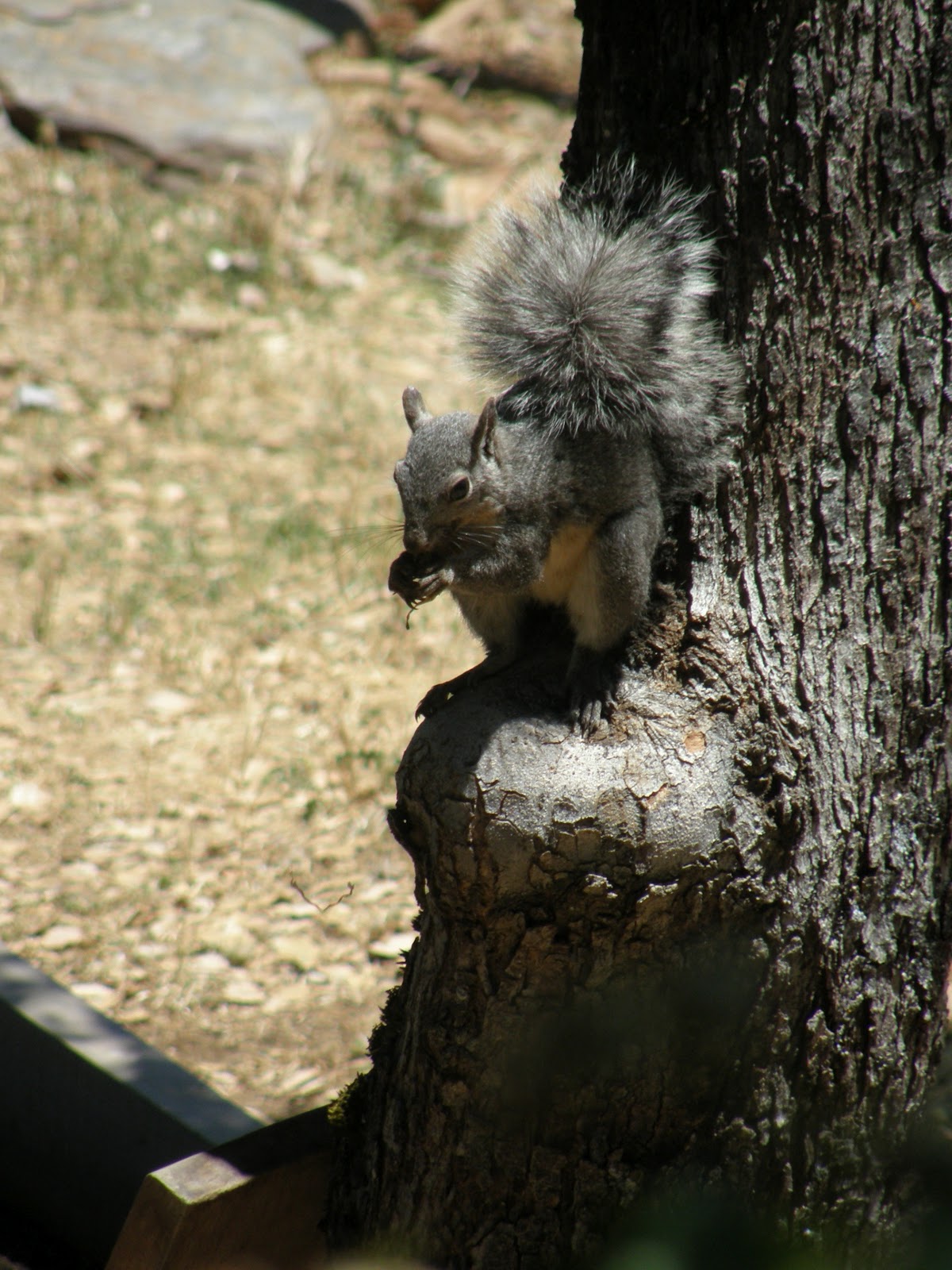
Now, fast forward an hour and David and I are sitting on the porch over lunch. I spot a gray squirrel making the very same furtive moves, out in the vegetable garden. I watch him as he slinks along, then stops to sit on his haunches and survey the surroundings for danger, then advances some more.

I whisper to David, “Watch this!” We observe as the squirrel jumps into one of the raised beds and immediately begins munching on tender young beet greens. David, who has worked very hard to nurture these babies along, is incensed. He sets down the spoon with which he is eating half a cantaloupe. He takes careful aim. David was a star baseball player in his day and his aim is more accurate than most. He heaves the melon rind and it falls exactly where the squirrel no longer is. 


Quicker than light, it has dematerialized and is now on the back side of a pine tree, galloping upward. It works its way around until it is about 30 feet directly above the beets. It goes out on a limb and lies, its four legs hanging in space, on its belly along the branch and gazes into the veggie bed, obviously contemplating its next move.


 David goes into the house for more ammunition. “The .22’s right there, by my chair,” I offer companionably. “No,” he responds, coming out of the house with a handful of cherries, “I’d probably miss and hit Martha.” Martha being our closest neighbor to the east.

The squirrel, obviously highly motivated, makes its move. Down the tree it comes, this time to raid the bird feeder for seeds. David lobs cherries to no avail. I go for my camera and get the shot of the squirrel eating a cherry.


Then it goes for the lettuce in the cold frame. Now I’m the one incensed. This is my turf and the source of my daily salads. I focus the camera on this scoundrel as if it were a gun sight. The squirrel sits on his haunches, stuffing his little cheeks with Mesclun and arugula as fast as his little jaws can move. In one final, heroic effort to defend our boundaries, David hurls the other half of his cantaloupe, which explodes right at the feet of our foe, who levitates and dematerializes.


Minutes late, our roof is under bombardment. Green pinecones are being flung from high in the branches of the pine that overhangs the house. They resonate through the house, disturbing the wah and alarming the fur children. The squirrel has an evil gleam of its own, apparently.

For the moment, our demesne is secure. We have a watch dog and two watch cats and an arsenal of lob-able produce and footwear. We are united in fiercely protective vigilance against critters red in tooth and claw. Things look safe for the foreseeable future. Like, maybe the next hour. But we can never relax our guard. There are barbarians at the gates. It’s a jungle out there.


Thursday, July 5, 2012

Morning Garden


 It may have been Independence Day but David and I worked like Trojan slaves in the gardens, yesterday. His focus is practical: he mounded potatoes, made teepees for the beans and watered his extensive vegetable crops. My focus is aesthetic: I planted a new bed of flowers and pots of geraniums and nasturtiums, washed the pillows and coverings for the outdoor furniture and generally fussed about.

This morning dawned cool and breezy and my first impulse was to go back to the garden, to survey our handiwork. The dawning light was so beautiful that I ran for my camera. The resulting photos are my gift to you, so that you can dip in and sip a bit of this tranquility, the way the bees are just rousing to do.

The geraniums I transplanted haven’t wilted down a bit. That freshly plumped chair was so inviting that I sat there to have my breakfast.


The iron bunny looks well pleased with his surroundings, this morning.


I couldn’t bear to cart the seed heads of the angelica and kale off to the compost heap. So I stuck them in the ash bucket that works so hard during the winter months, giving it a more glorified function for the summer.


The Lilies of the Nile are just on the verge of blooming.


 The nicotiana is bursting like belated 4th of July fireworks.


The new babies look perfectly content.


The honeysuckle is luring several kinds of bees, including big black carpenter bees as big as the end of my thumb. They look exotic, in their shiny black armor, against the foofy petals.


The scabiosa and Echinacea are happily commingling.


And the fur children are sweetly at peace, as witness Sophia’s first cat nap of the day.


 It was harder to get a picture of Mac, since he was sitting on my lap in a little doggy meditation.


Blessings of the day to all! I hope it’s a bloomin’ beautiful one!


Wednesday, July 4, 2012

I Wish I Had a V-8


So put me on a highway and show me a sign, and take it to the limit, one more time.
--The Eagles
 

 It’s Independence Day! Bring forth the hotdogs, corn on the cob and sparklers! Except that the dogs are filled with pink slime. The corn is genetically modified and is causing rare cancers. And sparklers and all other fireworks are banned in this and five surrounding counties due to fire danger. The only thing going spectacularly up in smoke appears to be the American dream.

There are some things, however, that America has just done well, and that’s all there is to it! I know it’s popular these days to put American industry down, often with good reason. But on this 4th of July, I want to remember the good times and the good things. And one of the first things that comes to mind is the V-8 engine.

I love to drive fast. Put me behind the wheel of a good automobile and I will turn any country road into the Indy 500. When I was a junior in high school, my folks owned a 1960 powder blue ragtop Thunderbird. I can still remember the day I focused on the speedometer and realized it topped out at 120 mph. Nothing could stop me: I went straight down to Keystone, where Highway 108 has one of its few long, straight stretches, and put that car to the test. That big old V-8 didn’t even strain, as I pegged it. Give it wings and it could fly!

My senior year, I talked my folks into buying the new 1965 Ford Mustang, and into upgrading to the biggest engine it was possible to drop into it, with a four on the floor. It was metal fleck khaki green with a black vinyl top and it was hot! My favorite pastime was to take in down to the Red Hills, where the road, instead of having bridges over a stream, made U-shaped dips into the streambed. I would floor the Mustang and jump it across these drainages, which were four in number. Then turn around, and do it again. No fear of flying, in that buggy! (I can tell this, now that my folks, God bless them, have gone to their well-deserved and car maintenance-free rest.)

Alas, the V-8 engine seems to be going the way of the dodo bird. Gas prices and green-thinking have doomed it. Sometimes I wonder if I’ll ever get behind the wheel of a truly powerful car, again.

Other good products that have served me well are the typewriter and typewriter ribbon. I’ve demolished four complete typewriters in my writing life, before switching to the computer. I kind of miss the clickity-clack rhythm of typing, punctuated by the return throw of the carriage. I don’t, however, miss trying to do footnotes on the typewriter. Remember the cheat sheets that we had to roll in behind the top sheet, with a line drawn near the bottom to remind us to insert footnotes? Remember carbon paper? How about changing typewriter ribbons and the carbon that got on your fingers and everything you touched? Dem wuz da days!

David and I are going to make a hot soaking tub out of an old cast iron and enamel claw-foot tub with a propane heater underneath. We’ll have it out in the garden, where we can relax in full, scandalous view of the birds and flowers. But this plan may go awry for one reason: we were wondering, last night over dinner, if they still manufacture rubber drain plugs to fit our tub?  Or have they gone the way of the typewriter ribbon and the two-party telephone line?

Tomorrow we’ll drive down to some big box store to find out, lamenting the loss of Mundorf’s Hardware, where you could find every single hardware need supplied. We’ll be in my Toyota Camry, which, in spite of its 4-cylinder engine, is still a pretty snappy little car. I’ll lead-foot it down and back up the mountain, hoping that someone tries to tailgate me, so I’ll have a good reason to mount a road race. It will be fun but . . . gee, I wish I had a V-8!

Happy 4th of July! May freedom and independence be yours, your whole life long, and may the red, white and blue (hopefully made in the USA, not China) wave over a land of excellence in all things, forever.